Kimba the White Lion
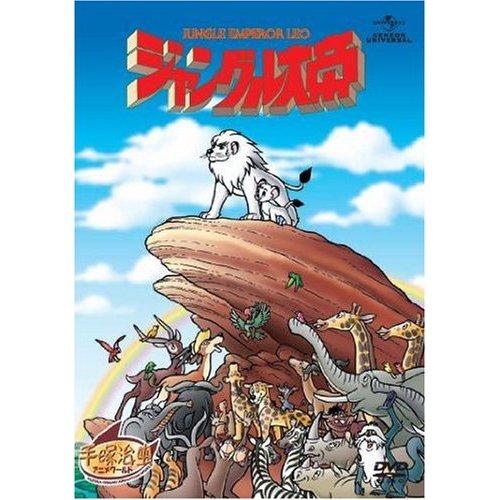
Also known as Janguru Taitei · Jungle Emperor · Jungle Emperor Leo · Jungle Taitei · Kimba · The New Adventures of Kimba the White Lion · ליאו · קימבה · קיסר הג'ונגל
- Years 1965-1966
- Episodes 52
- Country Japan
- Network Fuji TV
- First in color Japan's first official color animated TV series
- Japanese voice Yoshiko Ohta - Leo (Kimba)
- English voices Billie Lou Watt - Kimba (1966); Yvonne Murray - Kimba (1993 redub)
- US version NBC Enterprises, adapted by Fred Ladd; aired from 11 September 1966
- Awards St. Mark's Silver Lion, 19th Venice Film Festival (1967), for the theatrical version
- Other versions Sequel series (1966-1967), remake series (1989-1990), films in 1966, 1991, 1997, 2000 and 2009
Kimba the White Lion (Jungle Emperor, ジャングル大帝 Janguru Taitei, in Japan) is a manga by Osamu Tezuka, the "god of manga", serialized from 1950 to 1954. The anime, produced by Mushi Production, aired on Fuji TV from 6 October 1965 to 28 September 1966 (52 episodes). It was Japan's first color animated TV series.
The story follows Kimba, a white lion cub whose father Panja is killed by hunters and whose mother is shipped off to a zoo. Born at sea, Kimba survives a storm and is taken in by humans, where he learns the benefits of human culture.
Back in the African jungle, he sets out to continue his father's work and bring peace between animals and people.
The show spawned a sequel series, a 1989 remake and several films, and is also remembered for its striking resemblance to Disney's The Lion King.
Plot
In mid-20th-century Africa, as humans push into the continent, the white lion Panja (Caesar in the English dub) gives the jungle's wild animals a safe haven.
He angers nearby villagers, who hire a professional hunter, Ham Egg (Viper Snakely in the English dub). Rather than attack Panja directly, the hunter records his calls and uses them to trap Eliza, Panja's pregnant mate, as bait.
Panja is killed for his hide and Eliza is shipped off to a zoo.
Kimba is born on the ship, and his mother teaches him his father's ideals.
As a tropical storm approaches, she pushes him out through the bars of her cage.
The ship sinks, the fish help the cub learn to swim, and as he begins to despair the stars form his mother's face and encourage him. Butterflies guide him to shore.
Kimba lands far from home and is cared for by humans.
He learns the benefits of human culture and decides that when he returns to the jungle he will bring culture there and work for peace, like his father.
The series follows his first year back in the wild, as he learns that only communication and mutual understanding between animals and people will bring real peace.
Main characters
Kimba (Leo in Japanese) - the white lion cub, brave, kind and unusually wise, destined to become king of the jungle.
Panja (Caesar) - Kimba's father, the white lion who created a haven for animals.
He is killed at the start of the story and appears afterwards only in flashbacks.
Eliza - Kimba's mother, who sacrifices herself so her son can escape the ship.
Kitty (Lyre in Japanese) - the lioness Kimba loves.
Pauley Cracker (Coco in Japanese) - a talkative parrot who acts as Kimba's adviser.
Bubu - the lion who has taken Panja's place as king of the jungle and won't give up the crown easily.
The manga
Osamu Tezuka began Jungle Emperor in Manga Shōnen in November 1950, and it ran until April 1954, collected in three volumes.
The manga follows Leo through his whole life, from cub to adult lion.
Its second half became the basis for the sequel series and the 1997 film.
Japan's first color TV anime
The series was made at Tezuka's Mushi Production and planned in color from the start, unlike the Japanese series before it. An experimental color series, Dolphin Prince, had aired on the same network six months earlier but was cancelled after three episodes, so Jungle Emperor is considered the first official color anime series.
It aired in Japan on Wednesdays at 7 PM.
The American version
NBC Enterprises commissioned the English adaptation, which was handled by Fred Ladd, who also worked on Astro Boy. It aired in the US from 11 September 1966, with Billie Lou Watt as Kimba.
The American version softened some details: in the Japanese original Panja steals cattle from villagers to feed the carnivores, while in the English dub he merely frees them.
According to Ladd, the hero was first going to be called "Simba" (Swahili for "lion"), but an NBC executive found it too common to protect as a trademark, so it became "Kimba". The original name "Leo" was out because it was already the name of the MGM lion.
In 1993 the series was redubbed in English with Yvonne Murray as Kimba, a new opening and a new score by Paul J. Zaza.
The show aired around the world, including in Australia, Germany, Italy, Spain, France, Latin America and the Arab world.
Sequels and versions
Theatrical film (1966) - directed by Eiichi Yamamoto and released in Japan on 31 July 1966, it won the St. Mark's Silver Lion at the 1967 Venice Film Festival.
Sequel series (1966-1967) - Jungle Emperor: Onward, Leo!, with Leo as an adult.
It aired in the US in 1984 as Leo the Lion.
Remake series (1989-1990) - Tezuka died in February 1989, and that October TV Tokyo began a new 52-episode version by Tezuka Productions, with a very different plot and characters.
It was released in English in 1998 as The New Adventures of Kimba the White Lion.
OVA (1991) - Symphonic Poem, a 51-minute Madhouse film set to Isao Tomita's music.
Theatrical film (1997) - Jungle Emperor Leo, directed by Hiro Takeuchi, loosely based on the second half of the manga.
Short film (2000) - a 9-minute short shown at Tezuka Osamu World in Kyoto.
TV film (2009) - made for Fuji TV's 50th anniversary, directed by Gorō Taniguchi with character designs by Yoshitaka Amano.
It tells an entirely new story set in an artificial jungle of the future.
The Lion King controversy
When Disney's The Lion King came out in 1994, many pointed to similarities with Kimba: the heroes' names (Kimba and Simba), a lion father who is killed, a wise baboon, an adviser bird, hyenas, and even a scene where a dead parent's face appears in the sky. Fred Ladd called the parallels "stunning", and 488 Japanese cartoonists and animators signed a petition asking Disney to acknowledge the inspiration.
Disney said the resemblance was coincidental, that the filmmakers didn't know Kimba, and that the film was inspired by Hamlet.
Director Roger Allers noted that a baboon, a bird or hyenas are nothing unusual in a film set in Africa, and "simba" simply means "lion" in Swahili.
Tezuka's family and Tezuka Productions never sued Disney.
The company's director said the plot similarities "are based in the facts of nature", and Makoto Tezuka, the creator's son, said he did not want his father's work used as a weapon against Disney.
Tezuka himself was influenced by Disney films in his youth.
Matthew Broderick, the voice of adult Simba, recalled that when he was cast he first thought the film was about Kimba, which he remembered from childhood.
Legacy
In 1978 the adult Leo, designed by Tezuka himself, became the mascot of the Seibu Lions baseball team and appeared on the players' caps and helmets for decades.
According to manga scholar Frederik Schodt, by the 1980s it was almost impossible to visit Tokyo without noticing him.
Characters from the series made cameos in other Tezuka works and in the game Astro Boy: Omega Factor.
In 2013 Lacoste released a shirt collection featuring art from the manga.
Two video games were planned, for the Famicom (1990) and the Nintendo 64, but both were cancelled.
Series details
- Original title
- ジャングル大帝 (Janguru Taitei - "Jungle Emperor")
- Network
- Fuji TV
- Studio / production
- Mushi Production
- Genre
- Anime · Adventure · Drama · Talking animals
- Episode length
- About 23 minutes
- Based on
- The Jungle Emperor manga by Osamu Tezuka (Manga Shōnen, 1950-1954)
- Creators
- Osamu Tezuka
- Writers
- Masaki Tsuji · Tsuyoshi Ishigōoka · Shunichi Yukimuro
- Directors
- Eiichi Yamamoto · Shigeyuki Hayashi (Rintaro)
Music
Music by Isao Tomita.
The Japanese opening "Jungle Taitei" was sung by Tadahiko Hirano, and the ending "Leo no Uta" ("Leo's Song") by Mieko Hirota.
The American theme was written by Bernie Baum, Bill Giant and Florence Kaye and sung by Bill Giant.
Tomita's Jungle Emperor Symphonic Poem was released on LP in 1966.
Did you know?
- Kimba, not Simba The hero was going to be called "Simba" in the American version, but an NBC executive found the name too common, so he became "Kimba". The Japanese name "Leo" was already taken by the MGM lion.
- A Springfield parody In a 1995 episode of The Simpsons, Mufasa's ghost tells Lisa: "You must avenge my death, Kimba... I mean, Simba!"
- A cease-and-desist from Disney In 1997 Canada's Fant-Asia festival received a cease-and-desist letter from Disney trying to stop a screening of Jungle Emperor Leo. The film screened anyway to a full house, but it was its last ever North American screening.
- Baseball mascot Adult Leo has been the mascot of the Seibu Lions baseball team since 1978. His sister Lina was created especially for the team.
- Box office The 1997 film earned about ¥430 million (about $5.4 million) in distribution income in Japan.
People: Eiichi Yamamoto, Masaki Tsuji, Osamu Tezuka, Shigeyuki Hayashi (Rintaro, Shunichi Yukimuro, Tsuyoshi Ishigōoka
Comments
No approved comments yet.