Samurai Pizza Cats
Also known as Cat Ninja Legend Teyandee · Kyatto Ninden Teyandee · Samurai Pizza Cats · החתולים הסמוראים · סמוראי פיצה קאטס · קיאטו נינדן טיינדי
- Years 1990-1991 (יפן); שידור בישראל בשנות ה-90 וה-2000
- Country Japan
- Network Experimental Channel 2; Children's Channel; Fox Kids; Jetix; Junior
- Episodes 54 in Japan; 52 in the Saban version (two Japanese episodes were not adapted)
- Western adaptation Saban Entertainment - dialogue, names and music extensively rewritten
- Music (Japan) Kenji Kawai
- Music (Saban) Shuki Levy and Haim Saban
- Hebrew dub Two separate productions: Daond Studios (early 1990s) and Tomitot (2000)
Samurai Pizza Cats (Japanese: Kyatto Ninden Teyandee) is a comedic anime series from Tatsunoko Production.
The original Japanese run aired in 1990-1991 with 54 episodes.
Outside Japan, Saban Entertainment released a heavily adapted 52-episode version that rewrote dialogue, renamed characters and replaced the music.
In Israel the series was popular through the 1990s and 2000s, with two separate Hebrew dubs: one in the early 1990s and another in 2000 for the Children's Channel, plus later reruns on Fox Kids, Jetix and Junior.
Plot
The story takes place in «Little Tokyo», a city blending traditional Japan with futuristic technology and populated by anthropomorphic animals.
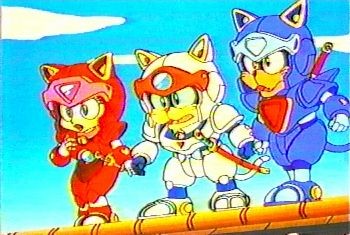
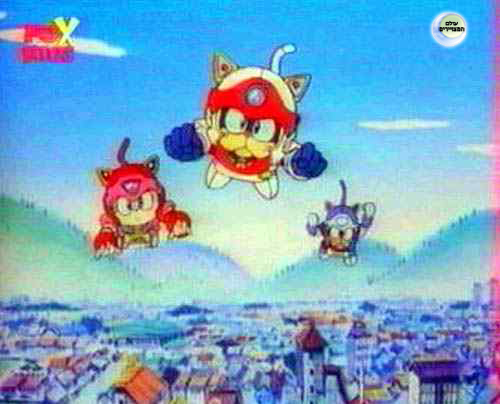
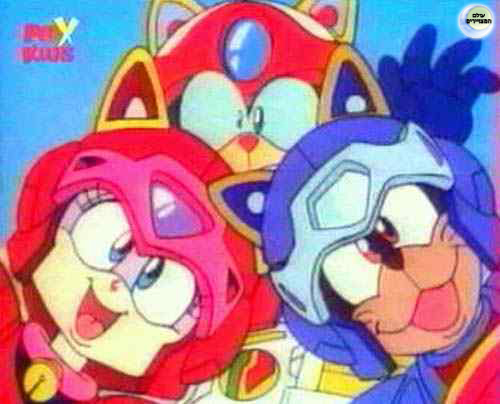
At the center are three cat warriors: Speedy, Anchovy and Polly Esther.
Outwardly they work at a pizzeria and deliver pizza, but in times of trouble they become the «Samurai Pizza Cats» and defend the city.
They are launched from the pizzeria base by cannon and sometimes get help from the rescue squad.
Their main enemy is the Big Cheese, who seeks to take over Little Tokyo with his advisor Jerry Atric and an army of crow ninja.
The crows are led by Bad Bird, Speedy's recurring rival.
The series mixes battles and adventure with comedy, parody, wordplay and fourth-wall breaks.
Characters
Speedy Cerviche / Yattarō - leader of the trio and a skilled fighter.
His signature weapon is the Ginzu sword.
His design is mainly white with red armor details.
Guido Anchovy / Sukashii - the blue cat of the group.
He fights in part with a special umbrella and is one of Lucille's two suitors.
Polly Esther / Pururun - the red-pink cat of the trio.
A fierce fighter who uses her claws among other weapons.
In the original Hebrew opening theme one line calls her «little Esther», but her dub name is Polly Esther.
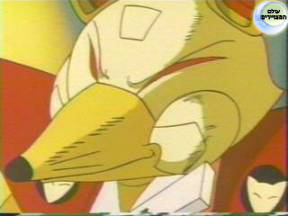
The Big Cheese / Kitsunezuka Kō'on-no-Kami - the main villain.
In the Saban version he is shown as a rat, while the original Japanese character is fox-based.
A recurring gag is his tendency to lose his composure and explode when his plans fail.
Bad Bird / Karamaru - commander of the crow ninja and Speedy's main rival.
Over the series his character develops and he is not always a one-dimensional villain.
Jerry Atric / Karasu Gennarisai - the Big Cheese's elderly, scheming advisor.
His English name is a pun on «geriatric».
Other characters include Emperor Fred, Al Dente, General Catton, Lucille, Francine and the rescue squad.
From the Japanese series to Samurai Pizza Cats
The original Japanese series Kyatto Ninden Teyandee had 54 episodes and aired in Japan from February 1990 to February 1991.
For the international market Saban Entertainment created Samurai Pizza Cats.
Unlike a straight translation dub, the Western version was a free adaptation: character names changed, dialogue was heavily rewritten and jokes, wordplay, pop-culture references and meta humor were added.
The music was replaced too. Kenji Kawai composed the Japanese version's score, while Shuki Levy and Haim Saban are credited on the Western version.
The Western version has 52 episodes.
Two Japanese episodes were not adapted for Saban, so episode numbering differs between the two versions.
Despite the name Samurai Pizza Cats, in the original Japanese version the heroes are actually identified as ninja.
The familiar Western title was created as part of Saban's adaptation.
Original Hebrew dub
The first Hebrew dub was produced in the early 1990s at Daond Studios Tel Aviv.
It relied on a very small team of five voice actors who played both regular and many guest and minor roles.
Dub production: Daond Studios Tel Aviv
Translation: Gabi Elad
Direction, recording and mix: Raviv Shanker
Tomer Sharon - Anchovy, narrator and others
Shai Zornitzer - Speedy and others
Yael Karavan - Polly Esther and others
Moti Dichne - Big Cheese, Bad Bird and others
Yehoachin Friedlander - Jerry Atric, Emperor Fred, Al Dente, General Catton and others
Over the years the cast has said the dub included ad-libs and local jokes, adding an Israeli humor layer on top of Saban's already free adaptation.
Original Hebrew opening theme
The first version received an original Hebrew opening song, different from Saban's opening.
Lyrics: Ziv Sidi and Raviv Shanker
Music: Avner Hodorov and Ziv Sidi
Performance: Moti Dichne
The song opens with «In Little Tokyo at the heart of the neighborhood...» and introduces the three heroes and their weapons, including Speedy's Ginzu sword, Anchovy's umbrella and Polly Esther's claws.
Children's Channel dub (2000)
In 2000 a second Hebrew version was produced for the Children's Channel by Tomitot, with a new and much larger team than the original dub.
Hebrew version production: Tomitot
Hebrew version: Yuval Liran
Language consultant: Eyal Padahzur
Direction: Shauli Halevi, Ariel Padahzur and Gadi Levy
Technicians: Tal Brosh, Ariel Padahzur, Shauli Halevi and Idan Peleg
Mix engineers: Ron Drorian and Tal Brosh
Music production: Efraim Dimantov
Music: Shuki Levy and Haim Saban
Credits list participants including Erik Eshet, Nir Ron, Shauli Halevi, Tal Brosh, Amir Ivgi, Ron Drorian, Asaf Avidan, Teresa Elia Zisman, Liraz Bergman, Gadi Levy, Uri Cohen, Tomer Gachum, Neta Shahar, Ariel Padahzur, Adi Halevi, Gitit Shoval and Chen Ofir.
Original credits do not list each actor's roles, so some role assignments found online are uncertain.
The 2000 opening theme is a Hebrew translation of the Western version's opening (translation: Gitit Shoval; vocals: Ron Drorian and Gitit Shoval) - unlike the original Hebrew song from the first dub.
Two Hebrew dub periods in Israel
Surviving recordings and documentation point to two Hebrew dub batches: the first 26 episodes were produced in the original Daond dub in the early 1990s, and the next 26 were dubbed by Tomitot in 2000.
As a result, viewers who saw the series in different periods may remember different voices and opening themes.
Video games
Kyatto Ninden Teyandee (1991) - an action game for Famicom based on the original anime, released in Japan.
Samurai Pizza Cats: Blast from the Past! - a 2D action/RPG by BLAST ZERO and Red Dunes Games.
The game lets players switch in real time between the cat team members, explore Little Tokyo, fight enemies and upgrade characters.
As of September 2026 the game's final release date had not been announced.
Trivia
The original Japanese series has 54 episodes; Saban's adaptation has 52.
The heroes are called «samurai» in the Western version even though in the Japanese original they are ninja.
Many Saban names are puns, including Speedy Cerviche, Polly Esther and Jerry Atric.
The name Guido Anchovy, source of the Hebrew name Anchovy, was created in the Western adaptation.
The first Hebrew dub used only five voice actors.
Israel produced two different opening songs: an original Hebrew song for the first dub and a translation of the Western opening for the 2000 version.
«Little Esther» is not Polly Esther's name - it is a phrase in the original Hebrew opening lyrics.
The «Ginzu sword» mentioned in the Hebrew opening is Speedy's Ginzu Sword in the Saban version.
The original Hebrew dub sometimes included ad-libs and Israeli references not in the American version.
Series details
- Network
- Experimental Channel 2; Children's Channel; Fox Kids; Jetix; Junior
- Studio / production
- Tatsunoko Production
- Genre
- Anime · Comedy · Action · Children
Music
Kenji Kawai (Japanese version); Shuki Levy and Haim Saban (Saban version)
Did you know?
- 54 vs 52 The Japanese series has 54 episodes; the Saban version has 52.
- Samurai or ninja? In the West they are «samurai»; in the Japanese original they are ninja.
- Little Esther «Little Esther» is a phrase in the original Hebrew opening - not Polly Esther's dub name.
People: Gadi Levy, Moti Dikna, Nir Ron, Shay Zornitzer, Tomer Sharon, Yael Karavan, Yehoyachin Friedlander, אורי כהן, אמיר איבגי, אסף אבידן, אריאל פדהצור, אריק עשת, גיתית שובל, חן אופיר, טל ברוש, לירז ברגמן, נטע שחר, עדי הלוי, רון דרויאן, שאולי הלוי, תומר גחום, תרזה אליה זיסמן
Image
Comments
No approved comments yet.